
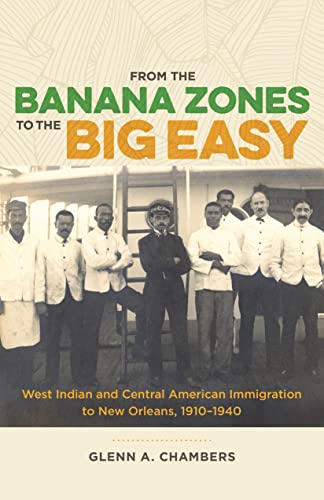
From the Banana Zones to the Big Easy: West Indian and Central American Immigration to New Orleans, 1910-1940



Description
Condition - Very Good
The item shows wear from consistent use but remains in good condition. It may arrive with damaged packaging or be repackaged.
From the Banana Zones to the Big Easy focuses on the immigration of West Indians and Central Americans―particularly those of British West Indian descent from the Caribbean coastal areas―to New Orleans from the turn of the twentieth century to the start of World War II. Glenn A. Chambers discerns the methods by which these individuals of diverse racial and ethnic backgrounds integrated into New Orleans society and negotiated their distinct historical and ethnoracial identities in the Jim Crow South. Throughout this study, Chambers explores two central questions: What did it mean to be “West Indian†within a context in which the persons migrating―or their parents, in some cases―were not born in the West Indies? And how did Central Americans grapple with this “West Indian†cultural identity when their political identity (citizenship) was Honduran, Costa Rican, or Panamanian? Chambers maintains that a distinct West Indian culture did not emerge in New Orleans. Rather, newly arrived West Indian practices intertwined with existing African American traditions, a process intensified in New Orleans’s established climate of incorporating, and often absorbing, new peoples and cultures.
The West Indian population in early twentieth-century New Orleans was truly transnational, multinational, multilingual, diasporic, and constantly evolving. These newcomers to New Orleans remained conscious of their West Indian roots but were not bound by them. Their experiences spanned nations but were not politically internationalist, as was the case with the larger West Indian communities in the northeastern United States. The ways in which individuals and families transitioned into U.S. constructions of race were at times the result of conscious decisions. In other instances, race was determined by the realities of everyday life in the Jim Crow South, in which whiteness translated into access and opportunity and all other ethnicities were relegated to a subordinate position. Many West Indians and Central Americans impacted by this system learned to navigate it in such a way that their ethnic and national identity all but disappeared from the historical record.
Through an analysis of arrest records, ships’ passenger records, foreign consulate reports, draft registrations, declarations of intent to apply for citizenship, naturalization applications, and city directories, Chambers recovers the lives of a small but significant population of immigrants who challenged the racial status quo.
Shipping & Delivery
Your order is shipped from the USA and delivered to your door in South Africa in 10–20 working days. All items are fully tracked.
Returns & Exchanges
We offer a 30-day return window. If something isn't right, contact our support team and we'll make it right.