
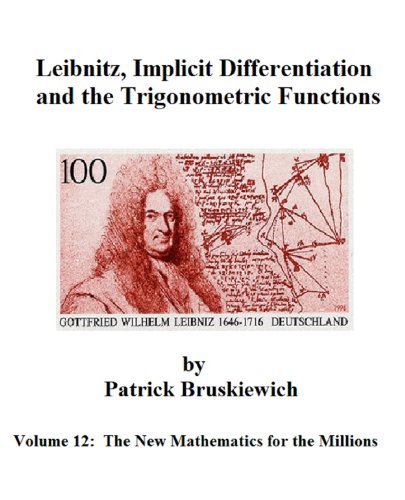
Leibnitz, Implicit Differentiation and the Trigonometric Functions (The New Mathematics for the Millions Book 12)
Product Description
Condition - Very Good
The item shows wear from consistent use but remains in good condition. It may arrive with damaged packaging or be repackaged.
Leibnitz, Implicit Differentiation and the Trigonometric Functions (The New Mathematics for the Millions Book 12)
It is generally believed that Isaac Newton invented differential Calculus, but in fact the ideas that are the foundations of differential calculus was being thought about in the years prior to Newton’s work. Newton’s intellectual predecessors included Cavalieri, Fermat, Pascal and Barrow,
Newton’s contemporaries included Huygens and Leibnitz and these great men each worked on a piece of an important question – the “Tangent Question†– the tangent question is simply, given a function f(x), what is the tangent (the infinitesimal slope) at point x?
Today we take the function f(x) for granted, however, the mathematics of the function had at some point to be developed. This was a major focus of the 17th century. Along with the development of functional analysis came the study of the rate of change of functions. This is where the Tangent Question rose to prominence.
It was left to Isaac Newton at Cambridge and Gottfried Wilhelm Leibnitz of Hanover Germany to set down a good response to the tangent question. Almost concurrently the two men fit the pieces of the puzzle together. Leibnitz’s first public account of his calculus was in a seven-page paper in the journal Acta Euroditorium of 1684.
In his Acta article Leibnitz introduced a novel and well thought out mathematical notation for differential calculus that is much more amenable to mathematical analysis than what had first been introduced by Newton.
The mathematician Simmons in his measure says this of Leibnitz (see Appendix One):
“Leibnitz is sometimes criticized for not producing any great work that can be pointed to or admired, like Newton’s Principia. But he did produce such a work, even though it is not in a book. The line of descent for all the greatest mathematicians of modern times begins with him – not with Newton – and extends in unbroken succession down to the twentieth century.
He was the intellectual father of the Bernouillis; John Bernouilli was Euler’s teacher; Euler adopted Lagrange as his scientific protégé; then came Gauss, Riemann, and the rest – all direct intellectual descendants of Leibniz. He had predecessors, of course, as every great thinker does. But apart from this, he was the true founder of modern European mathematics.â€
When we think about Calculus it is Leibnitz’s notation, his
df(x) /dx
for differentiation and the integral sign
∫ g(x) dx
which we see in contemporary use.
Also, Leibnitz introduced the term “constantâ€, “variableâ€, “parameter,†and “transcendental†into mathematics, as well as “abscissa†and “ordinate,†which together he called “coordinates.†He is the first who used the word “function†in a modern fashion.
In this book we shall use the Leibnitz notation to demonstrate implicit differentiation, as well as derive the differentials for the trigonometric functions, as well as a number of interesting functions.
Technical Specifications
You might also like
An Introduction to Euler’s Treat and the Basic Trigonometric Identities (The New Mathematics for the Millions Book 1)
Principia: The Mathematical Principles of Natural Philosophy [Active Content]
Elements of Algebra
Differential Equations in 24 Hours: with Solutions and Historical Notes
Imaginary Numbers: and Their Roles in Engineering and Physics