
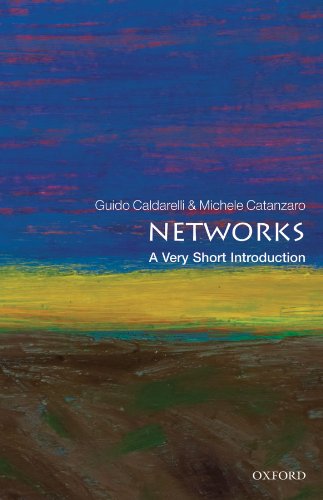
Networks: A Very Short Introduction (Very Short Introductions)
Product Description
Condition - Very Good
The item shows wear from consistent use but remains in good condition. It may arrive with damaged packaging or be repackaged.
Networks: A Very Short Introduction (Very Short Introductions)
From ecosystems to Facebook, from the Internet to the global financial market, some of the most important and familiar natural systems and social phenomena are based on a networked structure. It is impossible to understand the spread of an epidemic, a computer virus, large-scale blackouts, or massive extinctions without taking into account the network structure that underlies all these phenomena.
In this Very Short Introduction, Guido Caldarelli and Michele Catanzaro discuss the nature and variety of networks, using everyday examples from society, technology, nature, and history to explain and understand the science of network theory. They show the ubiquitous role of networks; how networks self-organize; why the rich get richer; and how networks can spontaneously collapse. They conclude by highlighting how the findings of complex network theory have very wide and important
applications in genetics, ecology, communications, economics, and sociology.
ABOUT THE SERIES: The Very Short Introductions series from Oxford University Press contains hundreds of titles in almost every subject area. These pocket-sized books are the perfect way to get ahead in a new subject quickly. Our expert authors combine facts, analysis, perspective, new ideas, and enthusiasm to make interesting and challenging topics highly readable.
Technical Specifications
You might also like

Complexity: A Very Short Introduction (Very Short Introductions)

Chaos: A Very Short Introduction (Very Short Introductions)
Information: A Very Short Introduction (Very Short Introductions)

Mathematics: A Very Short Introduction (Very Short Introductions)

Statistics: A Very Short Introduction (Very Short Introductions)

Risk: A Very Short Introduction (Very Short Introductions)
Game Theory: A Very Short Introduction (Very Short Introductions)
Probability: A Very Short Introduction (Very Short Introductions)

Quantum Theory: A Very Short Introduction (Very Short Introductions)