
Duke University Press

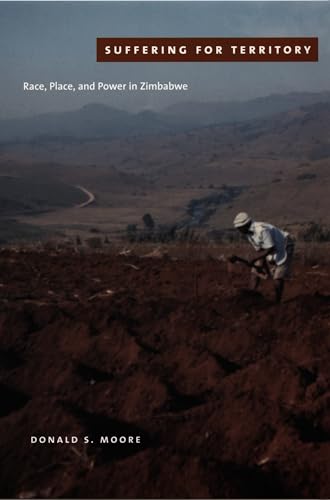
Suffering for Territory: Race, Place, and Power in Zimbabwe


Free shipping with 3 or more products in your cart
Payflex: Pay in 4 interest-free payments of R161.75. Read the FAQ
R 647
In stock
Low stock in USA warehouse Order soon to secure your order
Used, Good Condition
Duties, insurance and VAT included
Delivered in 10–20 working days —
Free shipping with 3 or more products in your cart
Secure checkout
Your payment is fully protected
Duties & VAT included
No surprise charges at the door
Tracked delivery
Track your order end to end
Returns support
30-day return window

Description

Condition - Very Good

The item shows wear from consistent use but remains in good condition. It may arrive with damaged packaging or be repackaged.

  • Used Book in Good Condition
Since 2000, black squatters have forcibly occupied white farms across Zimbabwe, reigniting questions of racialized dispossession, land rights, and legacies of liberation. Donald S. Moore probes these contentious politics by analyzing fierce disputes over territory, sovereignty, and subjection in the country’s eastern highlands. He focuses on poor farmers in Kaerezi who endured colonial evictions from their ancestral land and lived as refugees in Mozambique during Zimbabwe’s guerrilla war. After independence in 1980, Kaerezians returned home to a changed landscape. Postcolonial bureaucrats had converted their land from a white ranch into a state resettlement scheme. Those who defied this new spatial order were threatened with eviction. Moore shows how Kaerezians’ predicaments of place pivot on memories of “suffering for territory,” at once an idiom of identity and entitlement. Combining fine-grained ethnography with innovative theoretical insights, this book illuminates the complex interconnections between local practices of power and the wider forces of colonial rule, nationalist politics, and global discourses of development.

Moore makes a significant contribution to postcolonial theory with his conceptualization of “entangled landscapes” by articulating racialized rule, situated sovereignties, and environmental resources. Fusing Gramscian cultural politics and Foucault’s analytic of governmentality, he enlists ethnography to foreground the spatiality of power. Suffering for Territory demonstrates how emplaced micro-practices matter, how the outcomes of cultural struggles are contingent on the diverse ways land comes to be inhabited, labored upon, and suffered for.

Shipping & Delivery

Your order is shipped from the USA and delivered to your door in South Africa in 10–20 working days. All items are fully tracked.

Returns & Exchanges

We offer a 30-day return window. If something isn't right, contact our support team and we'll make it right.