
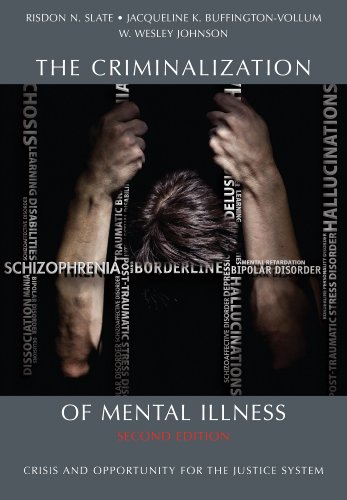
The Criminalization of Mental Illness: Crisis and Opportunity for the Justice System



Description
Condition - Very Good
The item shows wear from consistent use but remains in good condition. It may arrive with damaged packaging or be repackaged.
For a myriad of reasons the criminal justice system has become the de facto mental health system. This book explores how and why this is the case. Sensationalized cases often drive criminal justice policies that can sometimes be impulsively enacted and misguided.
While there are chapters that examine competency, insanity, and inpatient and outpatient commitment, the primary focus of the book is on the bulk of encounters that clog the criminal justice system with persons with mental illnesses (pwmi). Criminal justice practitioners are often ill-equipped for dealing with pwmi in crises. However, via application of therapeutic jurisprudence principles some agencies are better preparing their employees for such encounters and attempting to stop the inhumane and costly recycling of pwmi through the criminal justice system.
Coverage runs the gamut from deinstitutionalization, to specialized law enforcement responses, to mental health courts, to jails and prisons, to discharge planning, diversion, and reentry. Also, criminal justice practitioners in their own words provide insight into and examples of the interface between the mental health and criminal justice systems. Throughout the book the balance between maintaining public safety and preserving civil liberties is examined as the state's police power and parens patriae roles are considered.
Reasoned, collaborative approaches for influencing and informing policies that are often driven by crises are discussed; this book also reflects more psychological underpinnings than the 1st edition, as one of the co-authors new to this edition is a forensic clinical psychologist.
Shipping & Delivery
Your order is shipped from the USA and delivered to your door in South Africa in 10–20 working days. All items are fully tracked.
Returns & Exchanges
We offer a 30-day return window. If something isn't right, contact our support team and we'll make it right.


