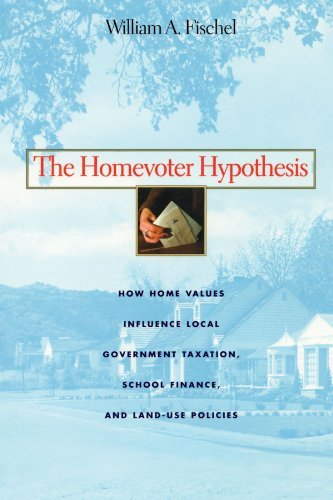
The Homevoter Hypothesis: How Home Values Influence Local Government Taxation, School Finance, and Land-Use Policies
Product Description
Condition - Very Good
The item shows wear from consistent use but remains in good condition. It may arrive with damaged packaging or be repackaged.
The Homevoter Hypothesis: How Home Values Influence Local Government Taxation, School Finance, and Land-Use Policies
Just as investors want the companies they hold equity in to do well, homeowners have a financial interest in the success of their communities. If neighborhood schools are good, if property taxes and crime rates are low, then the value of the homeowner’s principal asset―his home―will rise. Thus, as William Fischel shows, homeowners become watchful citizens of local government, not merely to improve their quality of life, but also to counteract the risk to their largest asset, a risk that cannot be diversified. Meanwhile, their vigilance promotes a municipal governance that provides services more efficiently than do the state or national government.
Fischel has coined the portmanteau word “homevoter†to crystallize the connection between homeownership and political involvement. The link neatly explains several vexing puzzles, such as why displacement of local taxation by state funds reduces school quality and why local governments are more likely to be efficient providers of environmental amenities. The Homevoter Hypothesis thereby makes a strong case for decentralization of the fiscal and regulatory functions of government.