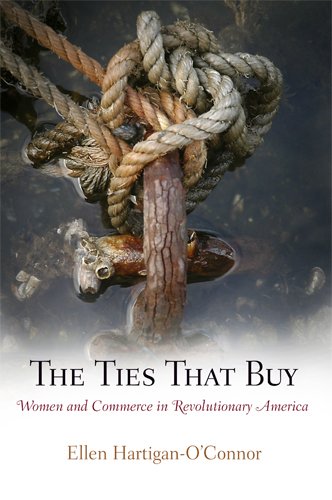
The Ties That Buy: Women and Commerce in Revolutionary America (Early American Studies)
Product Description
Condition - Very Good
The item shows wear from consistent use but remains in good condition. It may arrive with damaged packaging or be repackaged.
The Ties That Buy: Women and Commerce in Revolutionary America (Early American Studies)
- Used Book in Good Condition
In 1770, tavernkeeper Abigail Stoneman called in her debts by flourishing a handful of playing cards before the Rhode Island Court of Common Pleas. Scrawled on the cards were the IOUs of drinkers whose links to Stoneman testified to women's paradoxical place in the urban economy of the late eighteenth and early nineteenth centuries. Stoneman did traditional women's work—boarding, feeding, cleaning, and selling alcohol—but her customers, like her creditors, underscore her connections to an expansive commercial society. These connections are central to The Ties That Buy.
Historian Ellen Hartigan-O'Connor traces the lives of urban women in early America to reveal how they used the ties of residence, work, credit, and money to shape consumer culture at a time when the politics of the marketplace was gaining national significance. Covering the period 1750-1820, the book analyzes how women such as Stoneman used and were used by shifting forms of credit and cash in an economy transitioning between neighborly exchanges and investment-oriented transactions. In this world, commerce reached into every part of life. At the hearths of multifamily homes, renters, lodgers, and recent acquaintances lived together and struck financial deals for survival. Landladies, enslaved washerwomen, shopkeepers, and hucksters sustained themselves by serving the mobile population. A new economic practice in America—shopping—mobilized hierarchical and friendly relationships into wide-ranging consumer networks that depended on these same market connections.
Rhetoric emerging after the Revolution downplayed the significance of expanding female economic life in the interest of stabilizing the political order. But women were quintessential market participants, with fluid occupational identities, cross-class social and economic connections, and a firm investment in cash and commercial goods for power and meaning.
Technical Specifications
You might also like

Unruly Americans and the Origins of the Constitution

New England Bound: Slavery and Colonization in Early America

The Many Panics of 1837: People, Politics, and the Creation of a Transatlantic Financial Crisis

The United States Constitution: A Graphic Adaptation

Black Jacks: African American Seamen in the Age of Sail
Facing East from Indian Country: A Native History of Early America

National Duties: Custom Houses and the Making of the American State (American Beginnings, 1500-1900)

Freaks of Fortune: The Emerging World of Capitalism and Risk in America

The Labor Question in America: Economic Democracy in the Gilded Age (Working Class in American History (Paperback))