
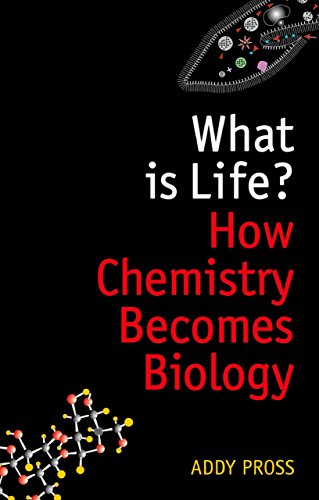
What is Life?: How Chemistry Becomes Biology (Oxford Landmark Science)
Product Description
Condition - Very Good
The item shows wear from consistent use but remains in good condition. It may arrive with damaged packaging or be repackaged.
What is Life?: How Chemistry Becomes Biology (Oxford Landmark Science)
Seventy years ago, Erwin Schrödinger posed a profound question: 'What is life, and how did it emerge from non-life?' This problem has puzzled biologists and physical scientists ever since.
Living things are hugely complex and have unique properties, such as self-maintenance and apparently purposeful behaviour which we do not see in inert matter. So how does chemistry give rise to biology? What could have led the first replicating molecules up such a path? Now, developments in the emerging field of 'systems chemistry' are unlocking the problem. Addy Pross shows how the different kind of stability that operates among replicating molecules results in a tendency for chemical systems
to become more complex and acquire the properties of life. Strikingly, he demonstrates that Darwinian evolution is the biological expression of a deeper, well-defined chemical concept: the whole story from replicating molecules to complex life is one continuous process governed by an underlying
physical principle. The gulf between biology and the physical sciences is finally becoming bridged.
This new edition includes an Epilogue describing developments in the concepts of fundamental forms of stability discussed in the book, and their profound implications.
Oxford Landmark Science books are 'must-read' classics of modern science writing which have crystallized big ideas, and shaped the way we think.
Technical Specifications
You might also like

Life's Ratchet: How Molecular Machines Extract Order from Chaos

Life's Engines: How Microbes Made Earth Habitable (Science Essentials)
Life Unfolding: How the human body creates itself
Genome: The Autobiography of a Species in 23 Chapters

Oxygen: The molecule that made the world (Popular Science)

The Quantum Story: A history in 40 moments (Oxford Landmark Science)
Life Ascending: The Ten Great Inventions of Evolution
What is Life? (Canto Classics)
Power, Sex, Suicide: Mitochondria and the meaning of life